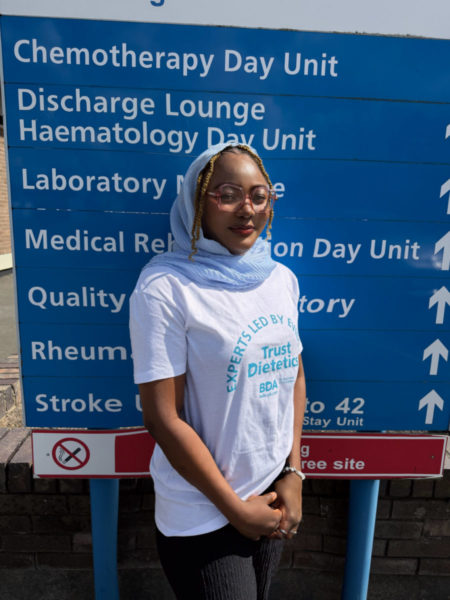
My name is Ruqqayyah Abidemi Balogun, MSc Dietetics (Pre-Registration) student at Teesside University.
Studying this course, I get the opportunity to bridge academic theory with professional practice through 1,000 hours of supervised clinical placement. Settings include the NHS and public health. I also contribute to research, sharpening my critical thinking and helping move the profession forward. Research gives a voice to those with lived experience, helps shape policies and guidelines, improves patient care, and helps identify gaps and challenges. Each piece of research has been different, reshaping the way I think about food, care and people – read more below.
My first project took me somewhere I wasn’t expecting – a dementia dance group at a local community centre. Research involved looking into a picture-based menu for people with dementia. The premise was practical – could this menu improve food choice, intake and dignity for people whose cognitive abilities had changed? I needed to gather feedback from families and patients on colours, image sizes, and any ideas that could be added to make menu usage easier and more effective. They all had similar frustrations with text-based menus, and described how family with dementia would often stare at the list of words, unable to translate them into a sense of appetite. The picture menus weren’t just a functional adjustment, they were a form of respect – it was a way of saying ‘you still get to choose.’ And of course, being a dance group, I danced, which was very therapeutic. The picture menus have been distributed to hospital wards and I’ve interviewed staff and guardians to review the effectiveness. We witnessed people with dementia on the wards make a lunch order using the picture menu, with fulfilling feedback. This research won a Dementia Care Team Award with Dementia UK on 30 April 2026.
I also took part in a patient and public involvement and engagement (PPIE) interview. These were conducted with adults diagnosed with long-term diet-related conditions, such as type 2 diabetes and cardiovascular disease, who experience emotional eating. PPIE is an essential cog within all research – it engages people with lived experience to join the research team and support the project, helping ensure it reflects the realities of people living with conditions. I worked with lived experience contributors to develop survey questions, where I not only needed to be a clinical dietitian but extend my skills to a research dietitian. It was refreshing to provide a platform for people to share their stories within the research design. Dietetics is not just a science of food and its nutrients, it is a practice of emotional and behavioural skills.
In addition, I visited York to observe the work of NHS researchers. Senior clinical researcher, Sarah Morris was supporting a treatment trial for Trontier – an experimental antibody designed to treat early-stage Alzheimer’s disease. She walked me through the questionnaire, assessment tools and eligibility criteria to evaluate whether participants could continue to participate in the trial. I observed a patient consultation, gaining insight into how questions were asked, and responses were recorded and updated into the system. I spent time with Angela McGloin, a clinical studies officer involved in a research study supporting physical activity for people with severe mental conditions (SPACES). The aim of SPACES is to help people with severe mental conditions become more physically active by adopting active lifestyles. I participated in two consultations with people who had lived experience, where we explored barriers and facilitators and completed questionnaires. Active listening proved to be a valuable skill throughout my time in the research department that day.
Deborah Green, a trust-wide food service dietitian, supervised and supported my research activities during my first long placement. During my second, I was supervised by Steph Smith as part of her role within the University’s Mental Health Leader Award. A key aim of this award is to strengthen the research capacity and capability across our region. I’m pleased I had the opportunity to build my research knowledge and confidence with her support and understand the importance of research for dietitians.
Towards the end of my placements, presentations were carried out – a strong component of a research project to demonstrate the ability to communicate what you found and why it matters.
By Ruqqayyah Balogun, a final-year dietetics student at Teesside University.