
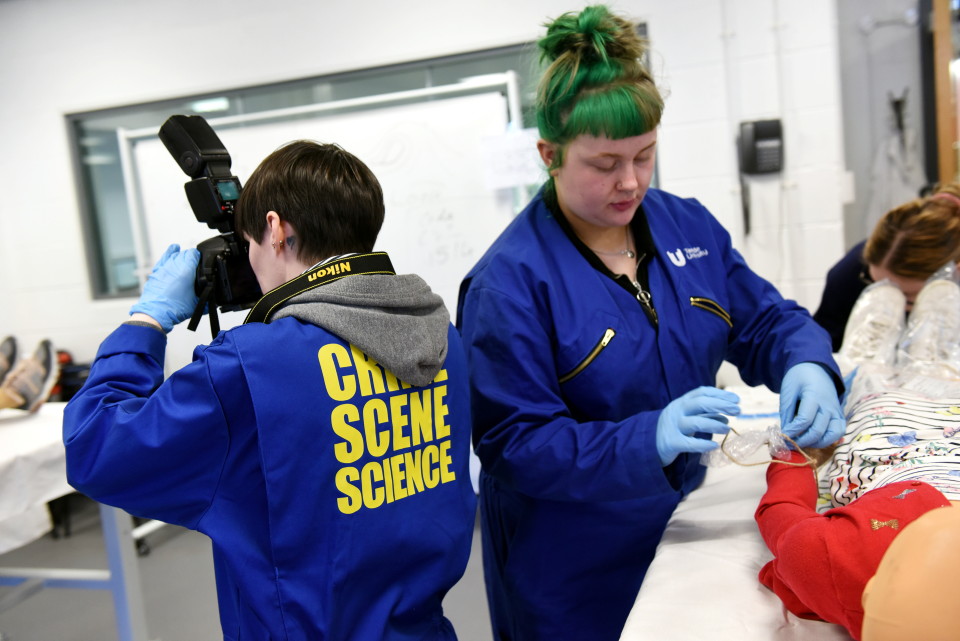
TV should be exciting and engaging – we want to be entertained, enthralled and captivated. But we should also appreciate what is real and what is entertainment.
Intelligence analysis in real life vs on TV
TV drama has a beginning, middle and end – sometimes you know who has done what, when and how they did it. Other times you are left guessing what has happened. The reality is that major crime investigations are often long and involve lots of highly skilled people – this is where real-life deviates from fiction.
On TV we often see print outs and drawings stuck on a board, with coloured pen and string connecting the dots. The ‘essence’ of this is true to an extent but 99% is false. Databases and software are needed with tools to allow analysts to search through evidence and descriptions. i2 Analyst Notebook presents data in different shapes, with features helping you see patterns more clearly. You can insert timelines, and capture intelligence that is confirmed, tentative or unconfirmed. Social Network Analysis can help find people that are the gatekeepers controlling the flow of information within the criminal enterprise, or those most connected/most active. Addresses can be exported into maps to instantly explore spatial intelligence. Just a few examples of how real-life use of intelligence management is light years ahead of TV drama.
Exhibit management is extremely well managed
Exhibit management is the labelling and recording of exhibits the moment they are seized. Following documentation protocol and adhering to quality standards is almost never covered on TV. Perhaps because it isn’t interesting, but it does provide a window into the professionalism in police and forensic services.
TV dramas often show the crime scene exhibit label being altered, usually by a corrupt police officer. Corruption is real – but it’s not that easy. When a crime scene investigator recovers evidence, they immediately label the item, packaging is brought into the scene and the item is logged. If blood is recovered on a swab, the swab is documented, as well as the bag. Everything is sealed in a bag with a tamper evident seal and each section of tape is signature sealed. At every opportunity, the exhibit number is part of the documented process, including physical items, notes and recorded information on computer systems. Any corrections need to be initialled and logged. Changing an exhibit label is going to raise suspicions and it would be nearly impossible to access and change all the repositories where the correct label is stored.
Murder investigations
TV dramas can be extremely unclear as to who does what in a forensic examination. In real life, pathologists work on behalf of the coroner and assist the police with their investigation. Crime scene investigators record the body in-situ at the post-mortem and package samples are given by the pathologist. They take all the necessary images – any specific locations at the scene and on the body. They also handle the body, fibre taping exposed skin and preparing it for transportation to the mortuary – a specialist coroners’ removal service is assigned for this. The coroner primarily wants to know the answer to four questions – who died, where did they die, when was it and how did it happen? The police assist in elements of this and focus on who is responsible. Getting these names and roles incorrect in TV drama causes confusion, and can diminish the complexity and professionalism.
Exact time of death is often difficult
TV dramas often narrow down a time of death to a small window. The reality is that pathologists ask two questions before giving their opinion – when was the deceased last seen and when were they found? There are many environmental and biological variables that influence a time of death and TV drama often presents this as a highly accurate process. In reality it has wider time tolerances and is more imprecise than audiences may believe.
The pathologist also has nothing to do with recording or recovering other forensic samples at the crime scene such as footwear and fingerprints. Their job is already intellectually and physically demanding – it doesn’t just include post-mortems, but it often involves writing statements and attending court. TV dramas tend to lump all forensic work into one role.
Uniform vs PPE
There needs to be a record of who entered a crime scene, when they entered and often why. Entering a crime scene without personal protective equipment (PPE) would be catastrophic on potential evidence. At no point should anyone go from one scene to another without decontaminating themselves, their clothing and their equipment. And no one in plain clothes or uniform should walk up to someone in full PPE at a crime scene and begin asking questions. Briefings are done away from the scene and full PPE is provided to anyone entering.
Does all this matter? After all, it’s only drama!
The answer is complex. On one hand it is just drama, but it could begin to change the way we engage with what the police do, and our perceptions and expectations of their work. This is known as the CSI effect and has been studied extensively. The conclusions from this research says that society understands what is real and what is not. Much of this has been researched in those taking part in jury service, with an impression that people do understand the differences between reality and fiction, even if they don’t know the processes involved.
Some could ask is this still relevant to debate? I believe that it is. As we move to an AI world, the sources we once relied on are changing. Search engines decreasingly provide immediate links to reliable data sources, instead opting for an AI snippet which could be a constructed truth. Myths and exaggerations are fine in entertainment, but not in online spaces when the public should be accessing how real police work is done – especially specialist forensic work.
By Mark Butler