
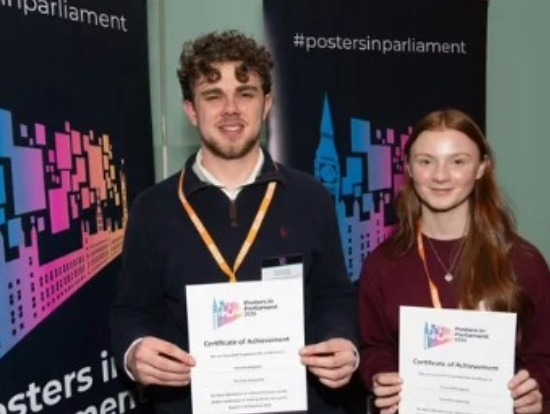
Max Hardingham and Gracie McLoughlin were recently invited to the Houses of Parliament to share research carried out while they were studying BSc (Hons) Physiotherapy at Teesside University’s School of Health & Life Sciences.
Max and Gracie share their experiences in this guest blog.
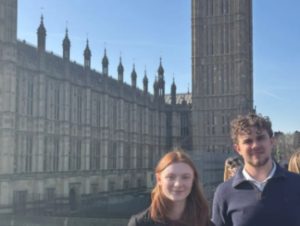
The Posters in Parliament conference showcases student research from across the country in a broad range of professions. This year the event was open to 50 students from across 27 UK higher education institutions.
Organised as part of the British Conference of Undergraduate Research, the aim is to provide parliamentarians and policy makers with an opportunity to learn more about the varied research being conducted by talented student researchers.
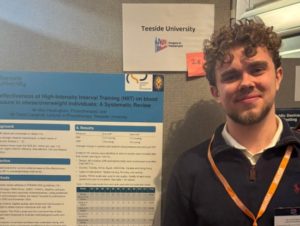
Max, now studying at Loughborough University towards a MSc in strength and conditioning, presented research he completed with Teesside University physiotherapy Lecturer Trevor Langford, which examined links between blood pressure and effectiveness of high-intensity interval training (HIIT) among obese people.
Max said: “Physiotherapy as a profession requires a lot of talking to patients and other healthcare professionals, so being able to build these skills throughout my studies have definitely benefitted myself when to comes participating to events and opportunities like this one.”
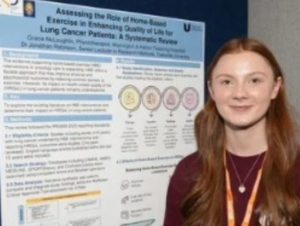
Gracie, now working as a physiotherapist at Warrington and Halton Teaching Hospital, presented research completed with Teesside University Research Methods Lecturer Dr Jonathan Robinson, which assessed the role of home-based exercise in enhancing quality of life for lung cancer patients.
Gracie said: “While my studies helped to build my evidence-based practice skills and clinical reasoning, one thing that really improved my confidence was completing a formal presentation during university.
“Preparing and delivering that presentation pushed me to explain complex information clearly and respond to questions on the spot. It strengthened my communication skills and made speaking in front of different audiences feel much more manageable. Clinical placements then helped me connect that research knowledge to real-life practice.”
Max added: “The Posters in Parliament experience has strengthened my confidence in communicating complex ideas in a clear, accessible way. Having to explain a piece of work to people who may not have the same background knowledge is a skill that transfers directly into clinical practice, research, and future leadership roles. It pushed me to think about how to make my message meaningful to different audiences, which is something employers really value.”
Gracie shared advice she would give to other students who are starting out on a research study, saying: “Choose a topic you are genuinely interested in. Start early and stay organised throughout. Don’t be afraid to ask supervisors questions and take all the feedback you can get. Say yes to any opportunities you are given.”

Teesside University physiotherapy lecturer Trevor Langford, who is also Honorary Vice-Chair of the Chartered Society of Physiotherapy North East regional network, said: “By attending such a prestigious event, it helps graduates to not only develop personally, but to also stand out amongst others, potentially increasing their employability. As academics, we actively seek to support students through their academic journey to ensure they are equipped for a career in Physiotherapy whether it is in clinical practice, research, education or leadership”.
Dissertation Module Leader and Physiotherapist, Dr Jonathan Robinson has been working to encourage students to consider the life of their research beyond submission. He said: “It is a privilege to support our students in taking their work beyond the classroom and into national research forums. Seeing their research presented in the Houses of Parliament, and discussed with MPs, peers and policymakers highlights the quality of the work our students produce, along with the real-world relevance of the topics they are exploring.”
Reflecting on his experience studying at Teesside, Max said: “Teesside University has provided me with a lot and developed my character over the three years I studied there. The facilities and teaching staff were particularly exceptional, and they allowed myself the opportunity like the Posters in Parliament to become the physiotherapist I am today.
“The experience has certainly strengthened my motivation to remain involved in research and to consider how academic work can inform policy and practice.
Gracie added: “Teesside University has genuinely supported me throughout the whole process. The lecturers were approachable and always willing to give feedback, which made a big difference when I was doubting myself. I’ve felt encouraged to take opportunities like this rather than just sticking to the minimum requirements. It made me feel confident representing both the university and physiotherapy as a profession.”