Walk into almost any corner shop and they are there, at the height of most children: brightly coloured cans promising boost in energy and improved concentration. For a lot of children and young people, energy drinks have become as ordinary as bags of crisps. As a public health researcher at Teesside University, that ordinariness is exactly what concerns me.
Energy drinks are high in caffeine and sugar, and research increasingly links heavy consumption among children and young people to poorer sleep, headaches, trouble concentrating, and effects on academic performance, mood, and wellbeing. Children’s lower tolerance to caffeine makes them more sensitive to these effects. When a product built to increase energy and “give wings,” ends up in school bags, it stops being a private choice and becomes a public health issue, especially with mounting evidence of adverse effects associated with the consumption of such products.
It is an issue with a particular edge here in the Northeast, a region that carries more than its share of health inequality. Habits formed young tend to stick, and the places where children grow up shape the choices in front of them, including what is stocked, and at what price, in the shop on the corner.
The policy world has noticed. From 2018, most major UK supermarkets voluntarily stopped selling energy drinks to under-16s, and in 2025 the government consulted on making that a legal ban in England. The direction of travel is clear. What is far less clear is whether a ban, on its own, will actually change how much children and young people drink.
That is the question at the heart of my PhD. The first part of my research pulls together the international evidence on what energy drink policies have and have not achieved. The second part does something the evidence has largely overlooked: it asks the people who will live with this policy what they actually think. Parents, teachers, retailers and health professionals all have a stake, and all see the issue from a different angle.
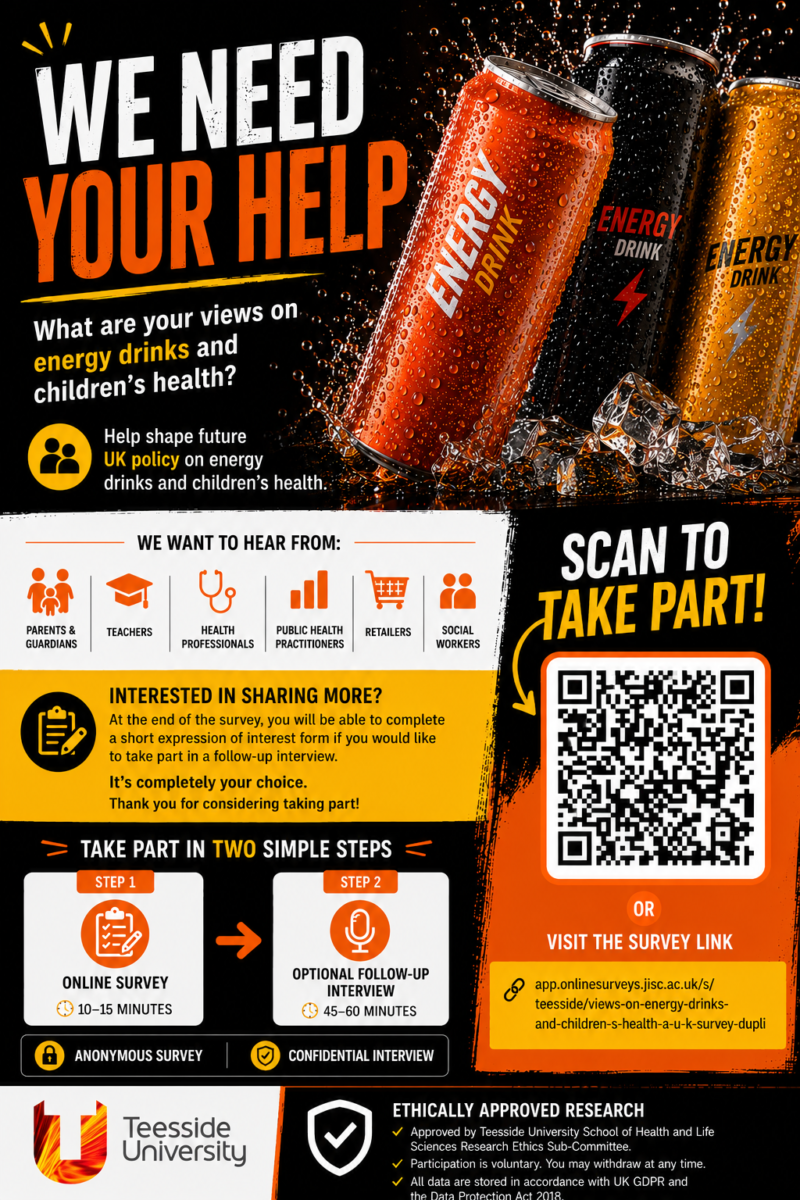
This is where you come in. A ban is only as strong as the shopkeeper who enforces it, the parent who backs it up at home, and the young person who accepts it. Understanding those views is what turns a well-meaning rule into one that works in the real world. I am currently running a survey and looking for people to take part in my research. The survey takes about 10-15 minutes to complete, and every response genuinely helps: Survey link: https://app.onlinesurveys.jisc.ac.uk/s/teesside/views-on-energy-drinks-and-children-s-health-a-u-k-survey-dupli
Good intentions are a starting point, not a guarantee. By bringing the evidence together with the voices of the people it affects, I hope this research can help make sure that, if the sale of energy drinks to under-16s is banned, the policy is built to actually protect the young people it is meant for.
Temitope Akinyemiju is a PhD researcher in School of Health and Life Sciences at Teesside University.