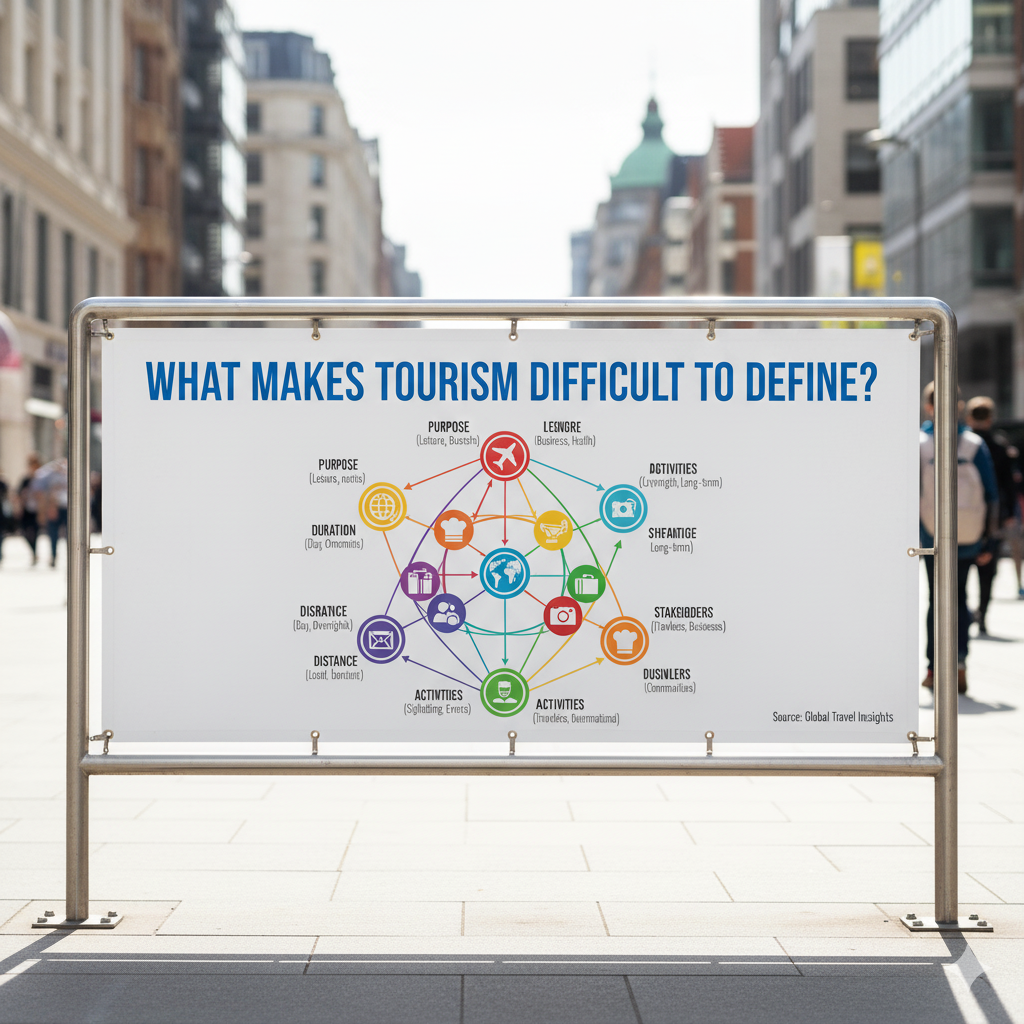
“What comes to mind when you think of a tourist? A backpacker? A family at a theme park? A businessperson in a hotel? The truth is, all of these could be correct.”
Diverse Types of Visitors
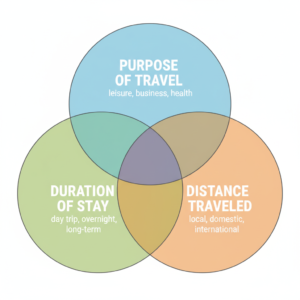
- Day vs. Overnight Visitors: Definitions struggle to include both day-trippers (who spend at least 3 hours away from home) and those who stay overnight, who are considered tourists.
- Business vs. Leisure Travelers: The definition must account for various motivations, including holiday, social events, and business, which can be challenging to distinguish.
- Non-Tourists Using Facilities: Some people use tourism facilities (like hotels or restaurants) for reasons other than tourism, such as local residents or researchers, complicating definitions.
No single tourism “industry”
- Fragmented supply side: Rather than a single “tourism industry,” the sector is a collection of many different component industries that serve travelers, including airlines, hotels, tour operators, restaurants, retailers, and more. Each of these has its own definitions and classifications, which creates inconsistent communication of tourism statistics (Stangl et al., 2024).
- Mixed customer base: Businesses considered part of the tourism sector, such as restaurants and shops, often cater to local residents as well as visitors, making it hard to measure the true economic value of tourism activity.
- Wide-reaching economic impact: Defining tourism’s economic impact is complex because it involves a long chain of expenditures that can affect many industries, including transportation, accommodation, entertainment, and retail. The effect extends from direct visitor spending to indirect and induced spending throughout the economy.
Challenges for measurement and policy
- Inconsistent data: The difficulty in defining tourism and tourists creates a challenge for data collection and analysis. Without consistent, agreed-upon definitions, it is difficult for different countries or even regions within a country to compare tourism statistics (Enzensberger, 1996).
- Policy planning: The lack of a uniform definition creates challenges for planners and policymakers, as they must define tourism based on their specific needs for measurement, planning, or advocacy. This can cause discrepancies in tracking trends or assessing a destination’s capacity.
- Holistic perspective: Increasingly, tourism is viewed not just as an economic activity but as part of a global socio-cultural and natural system. This means a modern definition must also consider broader issues like sustainability, local community engagement, and environmental impacts, further increasing its complexity.
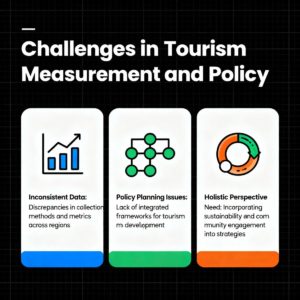
Image Credit: Perplexity.ai References:
- Enzensberger, H. M. (1996). A theory of tourism. New German Critique, (68), 117-135.
- Stangl, B., Li, Y., Ma, E., Xu, S., & Alsaied, M. (2024). Transferable skills in tourism and hospitality. Annals of Tourism Research, 109, 103854.