The amoeba proteus is a unicellular organism and therefore does not possess a nervous system. Instead, the amoeba proteus responds to external stimuli through receptors in their outer cell membrane such as chemoreceptors and mechanoreceptors which helps the amoeba proteus respond to external stimuli (Krauss 2001). The amoeba proteus can respond to various external stimuli within their environment such as chemicals, temperature, light, touch and even electrical fields and water currents (De la Fuente, Bringas, Malaina et al. 2019).
https://microbenotes.com/wp-content/uploads/2020/11/Structure-of-of-Amoeba-proteus.jpg
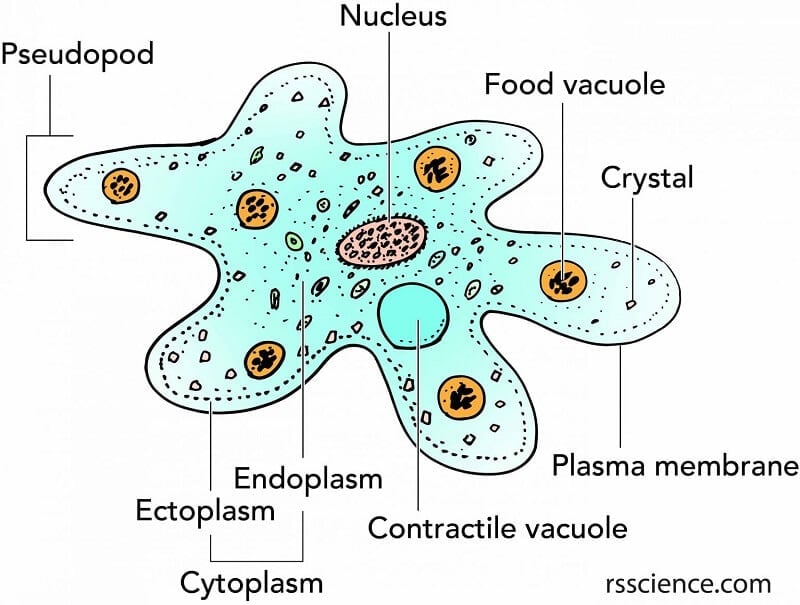
The diagram above shows the amoeba proteus and its inner structures. The plasma membrane is the outer layer enclosing its organelles, the amoeba proteus regulates itself through several internal stimuli such as chemical signals when nutrients are low, prompting them to search for food (Prusch and Minck 1985). The organelles within the amoeba proteus each play specific roles to ensure overall maintenance of the amoeba proteus. The mechanisms involved in stimulus detection involve protein receptors which can bind to molecules in a response to stimuli and activate biochemical changes within the cell (Krauss 2001). The amoeba proteus relies on decentralised signal processing rather than centralised as it does not have a central brain as such and several different processes are involved in its responses to both external and internal stimuli. It is simple in its responses, moving away or towards different stimuli, known as taxes, based on its needs. For example, phototaxis which is the movement away or towards light. These different chemical and mechanical responses allow it to effectively hunt for food and move towards it and extend its pseudopodia to capture the prey into a food vacuole (Prusch and Minck 1985).
We will now look at the Plecotus Auritus commonly known as the brown long-eared bat and compare the differences in its responses to stimuli, pictured below:
Braunes-Langohr-Plecotus-auritus_Dietmar-Nill-2.jpg (900×589)

The Plecotus auritus possesses a nervous system unlike the amoeba proteus and is a multicellular organism. Plecotus auritus can respond to their external environment in many ways. Their eyes are big and they have exceptional eyesight capabilities, (Cranbrook 1963) which helps with searching for prey in places that may be dark or poorly lit. They also have amazing hearing abilities at low frequencies (Coles, Guppy and Anderson, et al 1989) which is essential for hunting insects, allowing them to detect sounds such as the fluttering of a moth’s wings. Echolocation is also used for navigation and social signals between other members of their group (Furmankiewicz and Jones 2022). The Plecotus auritus has a strong internal stimulus when it comes to seeking food and hydration, they do not wait until energy levels become drastically low (Jersey Bat Group 2025), instead they will prioritize seeking out food sources by flying daily and even staying out longer than normal. Migration is also used as a tactic to survive harsh winter conditions (Strelkov 1969), and some choose to hibernate instead. Hibernation in the body is maintained through dropping their natural body temperature but keeping their temperature at a slightly higher rate than their surroundings (Nedergaard and Cannon 1990) helping to ensure their survival. These mechanisms are carried out through internal physiological processes and through neural processing in the brain. This a key difference between the Amoeba proteus and the Plecotus auritus processing of signals. The Plecotus auritus responses are more behavioural related, for example social calls made to each other in their groups (Furmankiewicz and Jones 2022) and Amoeba proteus responses are more biochemical and straightforward in its approaches. Plecotus auritus responses to stimuli can vary between immediate to delayed depending on the type of stimulus, for example, when hunting for prey the responses may be more calculated and slower when carrying out a physical manoeuvre (Henningsson, Jakobsen and Hedenstrom 2018). Other reactions may be quicker such as immediate reflex responses such as a startled response to a sudden unexpected movement. Amoeba Proteus can also have quick immediate responses to stimuli even without a nervous system however their movement itself tends to be slower as it relies on cytoplasmic streaming to move around (Korohoda, Mycielska, Janda and Madeja 2000). Some responses of Plecotus auritus are innate such as hibernation and immediate reflex responses for example which are instinctive and crucial for its survival, others are learned responses based on their individual experiences such as social call recognition between group members and learning to navigate unfamiliar environments for hunting. These adapted responses are also critical to ensure they can keep thriving and remain flexible to circumstances they may find themselves in. Amoeba proteus is also capable of learned responses despite not having a brain or nervous system (De le Fuente et al 2019). The study titled Evidence of conditioned behaviour in amoeba shows that it can change its course of movement based on prior experiences.
In conclusion, there are many big differences between Amoeba proteus and Plecotus auritus in their responses to stimuli, but they share some surprising similarities. Both are capable of learned responses and possess innate responses, while the Plecotus auritus may be more complex and diverse in its reactions and the Amoeba proteus operates at a more simpler level, they both can adapt to ensure survival of their species and meet all their basic needs.
References:
Coles, R. B., Guppy, A., Anderson, M.E., & Schlegel, P. (1989). Frequency sensitivity and directional hearing in the gleaning bat, Plecotus auritus (Linnaeus 1758). Journal of comparative physiology A, 165 (2), 269-280. Doi.org.
Cranbrook, E (1963). Notes on the feeding habits of the long-eared bat. Suffolk Naturalists transactions, 11, 1-3.
De la Fuente, I. M., Bringas, C., Malaina, I., Fedetz, M., Carrasco-Pujante, J., Morales, M., Knafo, S., Martinez, L., Perez-Samartin, A., Lopez, J.I. Perez-Yarza, G., & Boyano, M.D. (2019). Evidence of conditioned behaviour in amoebae. Nature communications, 10 (I), 3690.doi.org
Eklof and Gareth Jones. Use of vision in prey detection by brown long-eared bats, Plecotus auritus. Johan Eklof and Gareth Jones. March 2003.
Furmankiewicz, J., & Jones, G (2022). Bats (Plecotus auritus) use contact calls for communication among roost mates. Mammalian Biology, 102(1), 51-60. Advance online publication. https://doi.org/10.1007/s42991-021-00190-7
Hedenstrom Anders, Lasse Jakobsen, John Hallam, Cynthia F. Moss. Directionality of nose-emitted echolocation calls from bats without a nose leaf (Plecotus auritus).
Korohoda W, Mycielska M, Janda E, Madeja Z. Immediate and long-term galvanotactic responses of amoeba proteus to dc electric fields. Cell. Motil. Cytoskelet. 2000;45:10-26. Doi: 10.1002/(SICI)1097-0169 (200001) 45:1&x0003e;3.0.Co;2-T.
Krauss, G. (2001). Biochemistry of signal transduction and reglation (2nd ed.) Wiley-VCH.
Nedergaard, J., & Cannon, B. (1990). Mammalian cold adaptation: Molecular changes in brown adipose tissue. Science progress, 74, 269-292.
Prusch RD, Britton JC. Peptide stimulation of phagocytosis in amoeba proteus. Cell tissue Res. 1987;250:589-593.doi:10.1007/BF00218951.
Prusch, R.D., & Minck, D.R. (1985). Chemical stimulation of phagocytosis in Amoeba proteus and the influence of external calcium. Cell motility, 5 (5), 429-436.doi.org
Strelkov, P.P. (1969). Migratory and stationary bats (chiroptera) of the European part of the Soviet Union. Acta zoologica Cracoviensia, 14 (16), 393-439.