Reproduction is a crucial biological process which occurs within all living systems and is required for a species survival. Reproduction can occur through both sexual and asexual reproduction with both methods having there advantages as well as disadvantages. Asexual reproduction occurs in prokaryotic microorganisms as well as in some eukaryotic single-celled and multicellular organisms. This form of reproduction requires only one parent and produces genetically identical offspring as the offspring are all clones of the original parent cell. There are numerous types of asexual reproduction including binary fission, budding, vegetative propagation, spore formation also known as sporogenesis, fragmentation, parthenogenesis and apomixis. Sexual reproduction occurs only within eukaryotic cells and is the combination of typically haploid reproductive cells from two individuals to form typically a diploid offspring. Sexual reproduction requires for the species to maintain two distinct types of individuals, males and females, this form of reproduction also produces genetically unique individuals which will present characteristics from both parents due to the combinations of genes. Plecotus auritus also known as the brown long eared bat is a multicellular mammal which is native to the uk which is an example of a species which reproduces by sexual reproduction. Amoeba proteus also commonly referred to as amoeba pro is a single called organism which is eukaryotic, commonly found in fresh water and reproduces asexually by binary fission. I will be comparing the reproduction between the brown long eared bat and amoeba pro, focusing on the type of reproduction, the processes involved including environmental influences as well as the advantages and disadvantages of both means of reproduction.
The brown long eared bat (Plecotus auritus) reproduces exclusively through sexual reproduction and is viviparous meaning it gives birth to live young which have developed and been nourished within the mothers body. Mating within this species requires male and female participants typically taking place during late summer to autumn, commonly at swarming sites near hibernation roosts (Altringham, 2011). The brown long eared bat exhibits an incredibly adapted reproduction strategy which can be characterised by seasonal breeding and delayed fertilisation mechanisms which allow for births to coincide with maximum resource availability. This strategy reflect strong selection pressures imposes due to seasonal climates on small endothermic mammals (Animal Diversity Web, 2025). Proceeding mating females will store viable spermatozoa within their reproductive tract throughout there hibernation, where ovulation and fertilisation will take place in late spring typically in April or May once they have emerged from hibernation. This strategy allows for environmental conditions to be more favourable for gestation as they allow for higher resource availability increasing the survival rate of offspring. Male and female bat gametes also known as sperm and egg cells will have haploid numbers of 16 chromosomes each and when fertilisation occurs this will form a zygote which will have a diploid number of 32 chromosomes. Once fertilisation has happened the now developing embryo will undergo a mammalian gestation period lasting roughly 60-70 days as it develops within the mother until the female gives birth to a single live pup which will be genetically unique, multiple births for this species is typically quite rare. When the pup is born it will be hairless, blind and completely dependent upon its mother and maternal care for its survival. Pups born in this period will be reared within maternity colonies in which females cluster together to both nurse and protect there young. Females will provide pups with energy rich milk that supports rapid growth through lactation, the pups flight ability typically develops after 3-4 weeks, while weaning will be completed by about 6-7 weeks postpartum. After this period juveniles will then begin independently foraging, however sexual maturity will not be reached until the following breeding season (UK Bat Conservative Trust, 2025).
Amoeba proteus also known as Amoeba pro reproduces via asexual reproduction which occurs through binary fission, which is a process that enables for rapid population growth given that favourable environmental conditions are met. Unlike the brown long eared bat reproduction within Ameba pro does not involve gamete formation or fertilisation which reflects its simple cellular organisation (Encyclopaedia Britannica, 2024). Binary fission within amoeba pro is heavily regulated by the cell cycle consisting of three critical stages including, growth and DNA replication, mitosis and cytokinesis. During the interphase stage the amoeba pro will increase in size as it replicates its DNA. Amoeba pro will exhibit unusually high DNA content a well as variable policy levels, which may depict accurate chromosome segregation during division (Eskovska and Cotter, 2019). Proceeding DNA replication the nucleus will undergo mitosis where it will progress through the typical cell stages typical within the eukaryotic phases including, prophase, metaphase, anaphase and telophase. During this process chromosomes which have been evenly separated condense at the centromeres into two daughter nuclei. Within the final stage known as cytokinesis the physical division of the cytoplasm occurs, within amoeba pro this process occurs through the gradual constriction of the cell membrane, resulting in two independent daughter cells which are genetically identical to to the parent cell. Reproductive rate within amoeba pro is heavenly influenced by environmental factors such as temperature and oxygen concentration, under optimal conditions division can occur every 24-28 hours allowing for rapid population expansion.
| https://www.sciencefacts.net/wp-content/uploads/2020/07/Binary-Fission.jpg | |
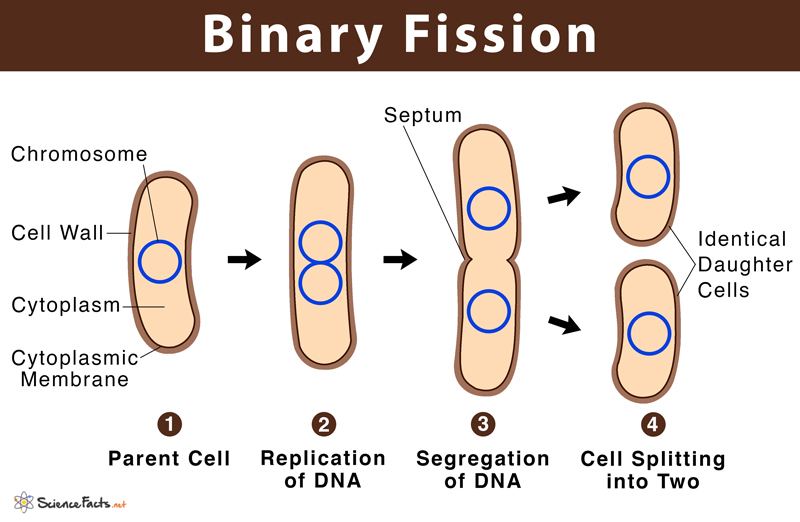
Figure 1 shows a visual depiction of binary fission (science facts, 2020)
Reproductive strategies within the brown long eared bat and amoeba pro demonstrate two fundamentally different approaches to survival, reflecting their contrasting levels of complexity. With the brown long eared bad utilising sexual reproductive strategies that are dictated by season as well as resource availability whereas amoeba pro utilises asexual reproductive stratergies through binary fission which is dictated by suitable environmental conditions such as temperature being optimal around 27 – 46 degrees Celsius. One drastic difference that can be noted between the twos reproductive strategies is parental care, as the brown long eared bat requires extensive parental investment. This includes lactation, thermoregulation and the mother caring for the pup as it is born blind and is unable to survive without the mother, whereas in contrast ameba pro produces two identical daughter cells which are immediately independent which allows for rapid population growth in a short time. However notable population growth for the brown long eared bat is not as fast paced with typically only birthing one pup during the year. The amoeba pros stratergie for reproduction enhances short term survival by enabling swift colonisation however it produces genetically identical clones leading to limited genetic variation meaning that populations are highly vulnerable to sudden changes in the environment as all individuals share the similar susceptibility. Whereas within the brown long eared bat sexual reproduction generates genetic diversity, increasing the potential of adaptation in changing environments and reducing susceptibility to disease.
Bibliography
Biology Online. “Asexual Reproduction – Definition and Examples – Biology Online Dictionary.” Biology Articles, Tutorials & Dictionary Online, 29 Oct. 2021, www.biologyonline.com/dictionary/asexual-reproduction.
Browner, Carole H, and Robin Root. “Cultural Contexts of Reproductive Health.” Elsevier EBooks, 26 June 2023, pp. 67–79, www.sciencedirect.com/topics/immunology-and-microbiology/reproduction, https://doi.org/10.1016/b978-0-323-99967-0.00020-x.
Gao, Shan, et al. “Meiosis-Associated Expression Patterns during Starvation-Induced Cell Fusion in the Protist Fisculla Terrestris.” BMC Biology, vol. 23, no. 1, 22 May 2025, pp. 140–140, https://doi.org/10.1186/s12915-025-02246-3. Accessed 8 Jan. 2026.
“Reproduction Methods | Biology for Majors II.” Courses.lumenlearning.com, courses.lumenlearning.com/suny-wmopen-biology2/chapter/reproduction-methods/.
Sato, Takato, et al. “Mating in the Cold. Prolonged Sperm Storage Provides Opportunities for Forced Copulation by Male Bats during Winter.” Frontiers in Physiology, vol. 14, 6 Sept. 2023, https://doi.org/10.3389/fphys.2023.1241470.
Science Facts. “Binary Fission: Definition with Examples & Diagram.” Science Facts, 13 July 2020, www.sciencefacts.net/binary-fission.html.
Tekle, Yonas I, et al. “Amoebozoans Are Secretly but Ancestrally Sexual: Evidence for Sex Genes and Potential Novel Crossover Pathways in Diverse Groups of Amoebae.” Genome Biology and Evolution, 13 Jan. 2017, pp. evx002–evx002, https://doi.org/10.1093/gbe/evx002. Accessed 11 Apr. 2024.
Trust, Bat Conservation. “Brown Long-Eared Bat – UK Bats – Bat Conservation Trust.” Bat Conservation Trust, 2019, www.bats.org.uk/about-bats/what-are-bats/uk-bats/brown-long-eared-bat?utm_source=chatgpt.com.
Trust, Woodland. “Brown Long-Eared Bat (Plecotus Auritus).” Woodland Trust, 2018, www.woodlandtrust.org.uk/trees-woods-and-wildlife/animals/mammals/brown-long-eared-bat/.
“Welcome to Zscaler Directory Authentication.” Animaldiversity.org, 2026, animaldiversity.org/accounts/Plecotus_auritus/?utm_source=chatgpt.com. Accessed 8 Jan. 2026.