Amoeba proteus (A.proteus) is a unicellular organism that has a predatory ecological niche found in aquatic terrains or bottom mud especially found within freshwater, ponds and many more (Shi et al., 2021), (Neupane., 2023). This is due to their preference for nutrient-rich and low-disturbance habitats as these areas are where prey density is very high (Neupane., 2023). Prey such as bacteria and smaller protists are found in these freshwater areas which causes Amoeba proteus to be found within larger ecosystems (Neupane., 2023). Within these food webs, these organisms act as micro-predators to keep the density of bacterium and protists low without directly disturbing the food chain (Shi et al., 2021). Alongside this, Amoeba proteus also reacts with many species throughout its life. A.proteus acts as a parasitism, this is where one organism lives within or on another benefiting by deriving nutrients from the host whilst slowly causing harm (Dinda et al., 2024). Many free-living A.proteus host many human pathogens as well as natural living pathogen found in the freshwater areas where Amoeba proteus is mostly found (Bornier et al.,2021). As well as this, Amoeba proteus acts as a predator to many different organisms surrounding it such as bacteria and protozoa. To feed on these organisms, A.proteus can form parts of their body into pseudopods (Biscontini., 2022). Due to their undefined shape and ability to manipulate their body in many ways, amoeba use these pseudopods and move towards the food (Biscontini., 2022). It then forms many different pseudopods which wrap around the prey and engulf it, trapping it inside the A.proteus itself (Biscontini., 2022). The specific pathogens are specifically selected through a process called chemotaxis where receptors can detect a chemoattractant which allow the pseudopods to detect these molecules (Shi et al., 2021). This is done through a process called phagocytosis which describes the ingesting of bacteria, which also describes the predation process A.proteus follows as shown in Figure 1 (Shi et al., 2021). Another way Amoeba proteus can react biologically is through mutualisms. This is where two different species interact and both positively benefit from the interaction such as food and protection (Shu et al., 2018). A key example of this is the reaction between Amoeba proteus and the unidentified strain of Gram-negative bacteria (Choi et al., 1991). The bacteria initially attack the A.proteus but then becomes essential for the survival and causes an essential relationship between the host and the bacteria (Choi et al., 1991).
Figure 1
In Figure one, the video shows how Amoeba proteus attacks its prey under a microscope using parasitism (mantismundi.,2016).
Plecotus auritus (brown long eared bat) is a multicellular organism which is a small mammal and a nocturnal predator (Bosso et al., 2025). These bats are native to Europe and parts of western Asia and are mostly found within mixed woodlands (Bosso et al., 2025). These brown long-ear bats interact with many different organisms through many different relationships. These species are the predators of many small invertebrates such as moths and earwigs (Trust., 2018). The Plecotus auritus is adapted to this role through their large ears providing sensitive hearing allowing them to be a gleaning insectivore as shown in Figure 2 (Trust., 2018). This means that the animal can catch insects by plucking them from a surface rather than catching prey only mid-air (Geipel et al., 2013), which is very important for the Plecotus auritus as these animals are mostly still at night (Trust., 2018). However, these organisms are prey for larger birds and mammalian predators. The biggest threat to this species is the domestic cat due to these bats sometimes being found under the roof of houses (Thompson., 2002). As well as this, they act as a host to parasites and pathogens by either living on or inside their body (Thompson., 2002). Competition is another biotic interaction the Plecotus auritus deals with. Compared to other species of bats, the brown long-eared bat does not have as much competition due to them hunting slower insects and using much more cluttered areas to other species (Thompson., 2002). As well as this, Plecotus auritus has an indirect mutualistic interaction with the plants in its niche. This works due to the bats keeping the number of predatory insects down whilst also contributing to ecosystem stability through trophic regulation (Shu et al., 2018). Plecotus auritus has many adaptations to allow them to react biologically, one being their very sensitive auditory system allowing them to hear their prey in much better detail than other species (Starik et al., 2021). Alongside this, they can lower their metabolic rate during torpor to conserve their energy even more (Starik et al., 2021).
Figure 2
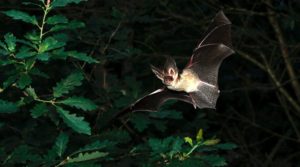
In Figure 2, you can see the ears of the Plecotus auritus which adapts them to be able to catch prey more readily.
As seen, both Amoeba proteus and Plecotus auritus have biotic interactions despite their vast differences in complexity and size. The largest difference between the two organisms is that Amoeba proteus is a unicellular eukaryote that is found in freshwater environment (Shi et al., 2021) and Plecotus auritus is a multicellular mammal that lives in woodland ecosystems (Bosso et al., 2025). Whilst Amoeba proteus functions within microbial food webs (Shi et al., 2021), the brown long-eared bat function in high trophic levels they both play a large role in regulating the population of prey (Bosso et al., 2025). Both organisms’ biotic interactions are mainly centred on predation even though the prey of each differ massively. Amoeba proteus feeds on bacteria and smaller protists and acts as a parasitism for these organisms (Dinda et al., 2024). Contrastingly, the brown long-eared bat feed on small insects and mammals in their niche (Trust., 2018). Differently to A.proteus, Plecotus auritus has competition within their niche meaning they hunt in different times and areas than other species of bats do. This highlights how both species differ through their ecological niches. Adaptation related to biotic interactions between the two species again shows the differences between the two species. Amoeba proteus has many physiological adaptations such as pseudopodia to be able to capture prey, using specialised digestive enzymes and uses phagocytosis to engulf the organisms needed (Biscontini., 2022). Plecotus auritus has many adaptations that allow them to readily find prey and possess specialised traits such as their passive hearing (Trust., 2018). Both also have behavioural adaptations like A.proteus responding to chemical cues from prey whilst bats use a combination of approaches to detect insects. In conclusion, the comparison between Amoeba proteus and Plecotus auritus illustrates that fundamental ecological principles governing biotic interactions apply universally across life regardless of organismal complexity. Both species engage in predation, experience competition and parasitism, and have evolved adaptations that enhance survival and feeding efficiency within their respective ecosystems. While their interactions occur at different spatial and trophic scales the underlying ecological processes remain consistent. This comparison emphasises the central role of biotic interactions in shaping evolutionary outcomes and structuring ecosystems from the microscopic to the macroscopic level.
Reference list
Biscontini, Tyler. “Amoeba | EBSCO.” EBSCO Information Services, Inc. | Www.ebsco.com, 2022, www.ebsco.com/research-starters/science/amoeba.
Bornier, Félix, et al. “Environmental Free-Living Amoebae Can Predate on Diverse Antibiotic-Resistant Human Pathogens.” Applied and Environmental Microbiology, vol. 87, no. 18, 26 Aug. 2021, https://doi.org/10.1128/aem.00747-21.
charlene.knox. “Brown Long-Eared Bats (Plecotus Auritus) Hold Significant Ecological Importance in Ireland.” OCSC | O’Connor Sutton Cronin | International Multidisciplinary Consulting Engineering Practice, 19 Oct. 2023, ocsc.ie/brown-long-eared-bats-plecotus-auritus-hold-significant-ecological-importance-in-ireland/. Accessed 7 Jan. 2026.
Choi, E.Y., et al. “Elevated Levels of Stress Proteins Associated with Bacterial Symbiosis in Amoeba Proteus and Soybean Root Nodule Cells.” Biosystems, vol. 25, no. 3, Jan. 1991, pp. 205–212, https://doi.org/10.1016/0303-2647(91)90006-7. Accessed 13 July 2020.
Dinda, Suman Kalyan, et al. “Amoebae: Beyond Pathogens- Exploring Their Benefits and Future Potential.” Frontiers in Cellular and Infection Microbiology, vol. 14, 2024, p. 1518925, pubmed.ncbi.nlm.nih.gov/39744153/, https://doi.org/10.3389/fcimb.2024.1518925.
Geipel, Inga, et al. “Perception of Silent and Motionless Prey on Vegetation by Echolocation in the Gleaning Bat Micronycteris Microtis.” Proceedings of the Royal Society B: Biological Sciences, vol. 280, no. 1754, 7 Mar. 2013, p. 20122830, https://doi.org/10.1098/rspb.2012.2830. Accessed 3 May 2021.
mantismundi. “Amoeba Hunts and Kills Paramecia and Stentor… To Music by Lamar; Genesis; Winter; Zimmer.” YouTube, 29 Dec. 2016, www.youtube.com/watch?v=4XlzCe5gDu0. Accessed 7 Jan. 2026.
Neupane, Laxmi. “Amoeba Proteus- Habitat, Culture and Structures.” Microbenotes.com, 3 Aug. 2023, microbenotes.com/amoeba-proteus-habitat-culture-structures/.
Shi, Yijing, et al. “The Ecology and Evolution of Amoeba-Bacterium Interactions.” Applied and Environmental Microbiology, vol. 87, no. 2, 4 Jan. 2021, https://doi.org/10.1128/aem.01866-20.
Shu, Longfei, et al. “Symbiont Location, Host Fitness, and Possible Coadaptation in a Symbiosis between Social Amoebae and Bacteria.” ELife, vol. 7, 31 Dec. 2018, https://doi.org/10.7554/elife.42660. Accessed 25 Feb. 2025.
Starik, Nicole, et al. “Spatial Behavior and Habitat Use of Two Sympatric Bat Species.” Animals, vol. 11, no. 12, 5 Dec. 2021, p. 3460, https://doi.org/10.3390/ani11123460. Accessed 17 Dec. 2021.
Thompson, Leah. “Plecotus Auritus (Brown Big-Eared Bat).” Animal Diversity Web, animaldiversity.org/accounts/Plecotus_auritus/.
Trust, Woodland. “Brown Long-Eared Bat (Plecotus Auritus).” Woodland Trust, 2018, www.woodlandtrust.org.uk/trees-woods-and-wildlife/animals/mammals/brown-long-eared-bat/.