
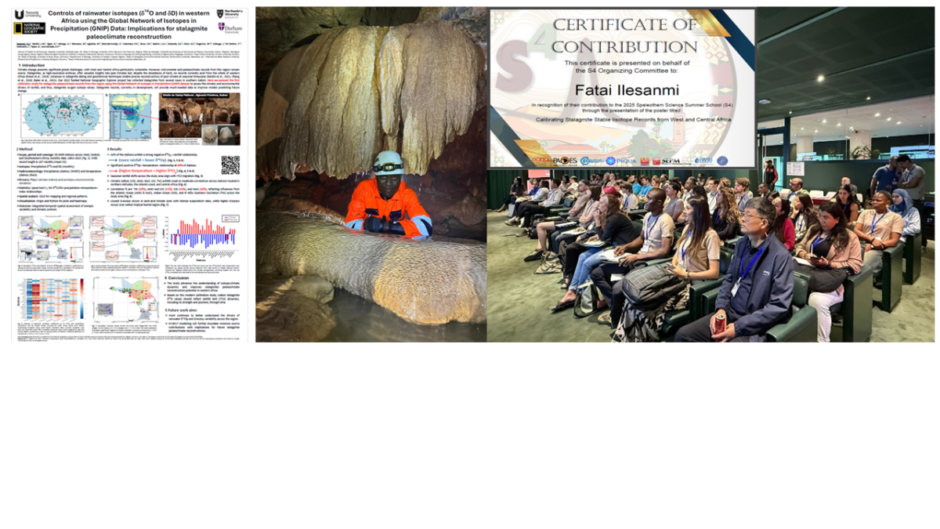
From 20 to 26 October 2025, our PhD candidate, Fatai Ilesanmi, participated in the 6th Summer School on Speleothem Science (S4 2025), held at Mohammed VI Polytechnic University in Ben Guerir and in Agadir, Morocco. The school brought together early-career researchers and leading experts for three days of lectures and workshops, followed by three days of fieldwork in North African karst systems, including the Tassroukht Plateau and Wintimdouine Cave, which hosts Africa’s longest-known underground river.
Across 12 lectures, we explored analytical methods, isotope geochemistry, age-model construction, cave monitoring approaches, and the use of speleothems to reconstruct past climate, environmental change, and human–environment interactions. Four focused workshops strengthened skills in data visualisation, geochemical modelling, community building, and career development, while two field days and two poster sessions created space for detailed discussion of 39 individual research projects.
I was pleased to represent Teesside University by presenting my poster, Controls of rainwater isotopes (δ¹⁸O and δD) in western Africa using the Global Network of Isotopes in Precipitation (GNIP) data: implications for stalagmite palaeoclimate reconstruction, co-authored with collaborators from Nigeria, Gabon, Cameroon, the UK, and Morocco, and supported by the National Geographic Society.
Beyond the formal programme, Summer School on Speleothem Science (S4 2025) was characterised by open exchange, mentoring, and new collaborations. I return with a stronger methodological toolkit, an expanded international network, and clear ideas for applying the concepts discussed in Morocco to my ongoing stalagmite-based palaeoclimate research in West and Central Africa.
Fatai gratefully acknowledged the S4 organisers and Teesside University for the travel grant, which supported his participation and the dissemination of these findings.
Summer School on Speleothem Science (S4 2025) in Morocco details: S4 2025